
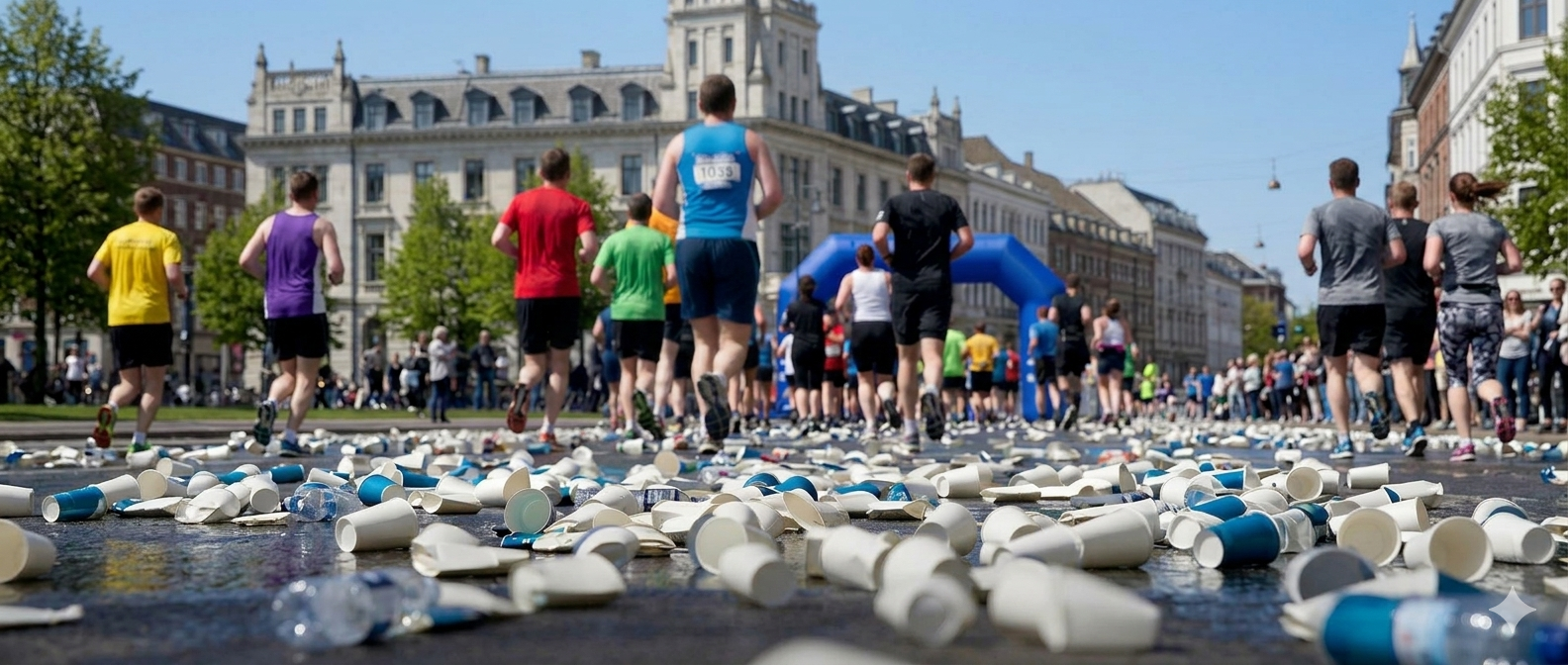
Every race you've run left
a trail of cups behind.
Running culture is booming. Sustainable running culture is not. This is a working resource on what's actually known about cup waste at races, who's solving it, and where the real friction sits.
~150,000
Single-use cups generated by one mid-size marathon — 9,000 runners across 17 aid stations. Used once. Thrown away.
The Numbers
Cup waste at races isn't a small problem dressed up as a big one. The scale is genuinely hard to picture until you put numbers on it.
Billions
Disposable cups used worldwide each year — across food service and events combined.
7.7 tons
Single-use cup waste at the Boston Marathon's hydration stations in 2025 alone.
100s of years
How long these cups can persist in landfills, depending on the lining and material.
The "paper cup" problem.
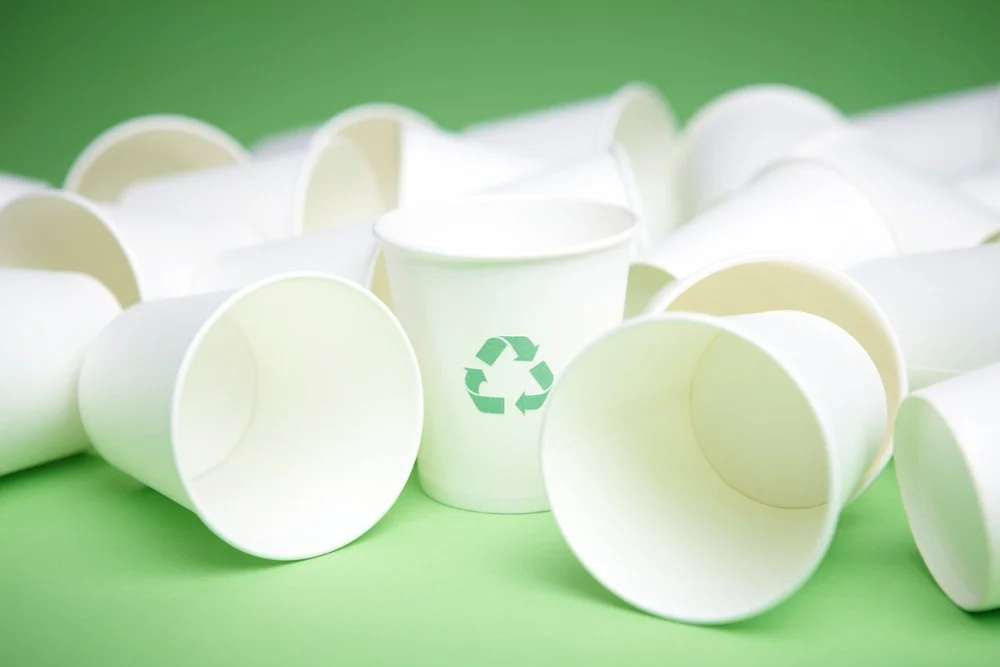
Most race cups look like paper. They're not, exactly. Even paper-bodied cups typically have a thin plastic lining that prevents them from biodegrading and complicates recycling. Manufacturing, transporting, and disposing of these cups all generate planet-warming greenhouse gas emissions. Eliminating cups at one major marathon can keep roughly 15 tons of CO₂ equivalent out of the atmosphere.
2. Case Studies
Change is happening — at scales from elite world marathons to scrappy trail ultras. Here's what's actually been tried, and the honest detail on what worked and what didn't.
-
Paris Marathon 2026
Paris ditched plastic bottles in 2024 and replaced them with paper cups. Then in 2026, with more than 55,000 finishers, it went fully cupless — a world first for an event that size. Every runner is now required to carry a personal hydration system: a soft flask, collapsible cup, or hydration pack.To compensate, organizers expanded aid stations from 8 to 13 and added water-spray stations for hot weather. The bet is that the runner-supplied model can scale up, not just down.
-
Testing the reusable cup model +
The BAA brought in 30,000 reusable silicone cups from Hiccup for its Boston 5K. Cups were collected at the finish, washed, and reused at future races. It's a softer entry point than going fully cupless — runners still get a cup at the aid station, it just doesn't end up in the trash.
-
The rental model +
Hiccup has kept roughly 902,000 disposable cups out of landfills by renting reusable silicone cups to races. The rental model lowers the barrier for race directors who can't or won't invest in permanent inventory, washing infrastructure, or dedicated logistics staff.
-
The culture that got there first +
Trail and ultra culture has been ahead of road racing on this for years. Many ultras have always required runners to carry their own hydration — soft flasks, bladders, collapsible cups — and the community has long treated it as part of the sport. It's a useful proof point: the behavior can become normal with the right framing.
3. Why It's Hard
"Just go cupless" sounds simple. In practice, race directors face real tradeoffs — and pretending they don't is how good ideas get rejected.
Safety and heat risk
Time-focused runners may skip aid stations rather than slow down to use a personal cup. On a hot day, that's a dehydration risk — a real medical concern, not a hypothetical one.
Logistics chaos
At Paris 2026, ready-filled bottle stations were undersized for the field. Reports describe "pure mayhem" at every station, with discarded hard plastic bottles becoming a slip and trip hazard for runners behind.
Cost
A disposable cup costs cents. Renting 10,000 reusable silicone cups runs around 15 cents each. For small races on tight budgets, that gap is real — and it's why the rental model has to keep getting cheaper to scale.
Equity in elite-vs-amateur rules
Paris allowed runners targeting sub-2:50 to use pre-filled personal bottles handed up by support crew — a perk common at elite races. Critics noted this advantage skews toward younger male runners, which complicates the framing of "everyone shares the burden."
The bigger-picture argument
Some argue cup waste is small relative to a race's total footprint — runner travel dominates. That's true. But visible waste shapes culture in a way carbon math doesn't, and culture is what eventually moves the bigger numbers.
4. The Spectrum of Solutions
"Cupless" isn't binary. Here's the ladder, from immediate wins to ambitious overhauls —
so any race can find an entry point.
Approach
Compostable cups + collection bins:
Best for
Large events with long planning runway
Trade-off
Runner-supplied hydration with
refill stations:
Any size race, immediate win
Still single-use; depends on local composting infrastructure
Reusable cup rental (e.g. Hiccup):
Fully cupless with upgraded aid stations:
Mid-size races
Trail races, smaller events
Higher per-cup cost; requires logistics partner
Requires runner education; not ideal in extreme heat
Most logistics-intensive; needs real safety planning
5. Where Zippy Cup Fits In
We'd rather earn the pitch than open with it. Here's where we honestly think a reusable silicone cup belongs in the picture you just read — and where it doesn't.
Problem 1
They get lost.
Generic collapsible cups slip out of pockets, fall off carabiners, or get dropped at aid stations. A cup you lost in mile 4 isn't reusable — it's just slower-decomposing trash.
Problem 2
They cost runners pace.
Most cups need two hands to unfold, hold under a spigot, drink from, and put away. At a 7-minute mile that's seconds you don't have — which is why time-focused runners just skip aid stations.
Problem 3
They're not built for the run.
Camping cups and coffee collapsibles weren't designed for sip-on-the-move use. The wrong shape, the wrong rim, the wrong attachment — small details that decide whether a runner uses it twice or never again.
What Zippy Cup is designed to be. A soft, foldable silicone cup engineered to stay on your waist — not in a pocket, not on a carabiner, not lost somewhere around mile 4. The attachment is the point. The cup locks to your belt or waistband through every stride, so it's right there the moment you want a sip and still right there when you cross the finish. No fumbling, no losing it, no skipping aid stations because the gear got in the way. One cup, many races, no paper trail.